
How to Start an Online Bus Ticket Booking Business (2026 Guide)
Bus Operations · Business Guides
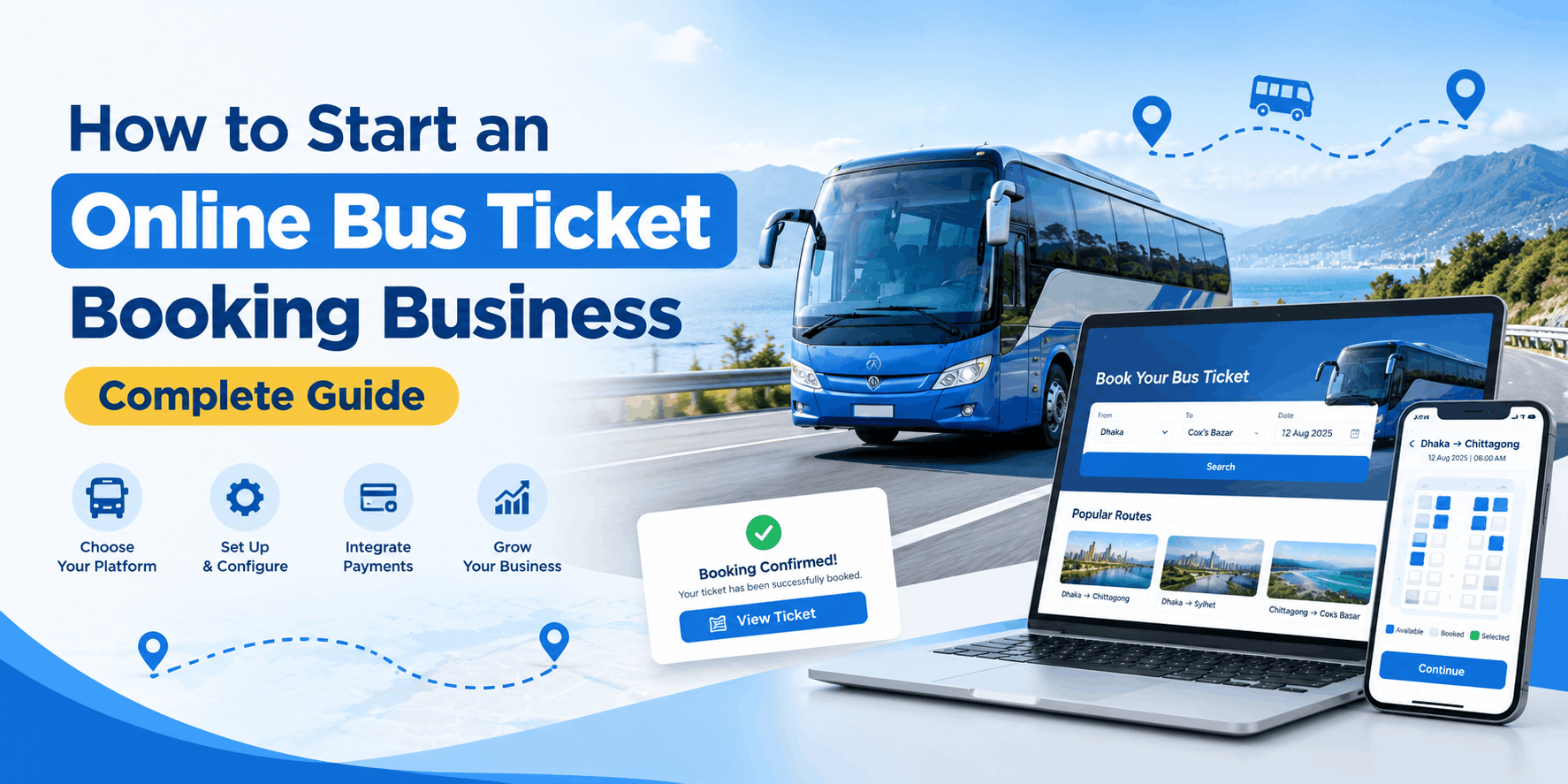
How to Start an Online Bus Ticket Booking Business (2026 Guide)
start bus ticket booking business · online bus booking business plan · how to start bus ticket business · bus ticketing business 2026 · bus reservation business setup · launch bus booking website · bus operator business guide · start a bus company online · bus booking software for new business
More travelers now book intercity buses the same way they book flights — from a phone, in a few taps, without calling a counter. That shift has opened a real opportunity for new operators and travel entrepreneurs: you no longer need a national brand or millions in funding to sell tickets online. You need a route, a fleet (owned or partnered), and the right booking system. This guide walks through every step of starting an online bus ticket booking business in 2026, including the part most guides skip — how to actually choose your booking software.
In this guide
- Is a bus ticketing business profitable in 2026?
- Step 1: Choose your business model
- Step 2: Handle licensing and permits
- Step 3: Set up your fleet and routes
- Step 4: Choose your booking software
- Step 5: Configure seat layouts and pricing
- Step 6: Set up payments
- Step 7: Launch and get your first bookings
- Common mistakes new operators make
- Frequently asked questions
Is a Bus Ticketing Business Profitable in 2026?
Intercity and regional bus travel remains one of the most consistent transport categories worldwide — it's cheaper than flying, more flexible than rail, and, unlike ride-hailing, runs on fixed routes that are easy to plan a business around. The margin comes from three places: filling seats reliably, keeping booking costs low, and reducing no-shows through pre-paid online tickets instead of counter sales.
The businesses that struggle are usually the ones giving away 10–20% of every fare to a third-party aggregator, or running bookings manually through phone calls and paper registers. Both problems have the same fix: owning your booking channel. We covered that trade-off in detail in our guide to self-hosted bus booking systems as a RedBus/AbhiBus alternative — worth a read once you're past the planning stage below.
Step 1: Choose Your Business Model
Before anything else, decide what kind of operator you're going to be:
- Single-operator: you own or lease the fleet and sell tickets directly under your own brand. Simplest to start, easiest to control quality.
- Route reseller / travel agency: you sell seats on other operators' buses through partnerships, without owning vehicles.
- Multi-operator marketplace: you build a platform where several bus companies list routes, and you take a cut per booking — essentially a mini RedBus. Much harder to launch, and rarely the right starting point.
For almost every new entrant in 2026, the single-operator model is the right starting point. It's the version this guide focuses on, and it's also the model most bus booking software — including the one referenced later in this guide — is built around.
Step 2: Handle Licensing and Permits
Transport licensing is one of the few parts of this process that's entirely local — requirements vary by country, state, and even city, so treat the list below as a starting checklist rather than a complete guide, and confirm the specifics with your local transport authority.
- Commercial passenger transport permit / route permit for each corridor you plan to run
- Vehicle registration and fitness certification for every bus in the fleet
- Driver licensing appropriate to passenger vehicle class, plus background checks where required
- Passenger insurance coverage
- Business registration and applicable tax registration for online ticket sales
Sort licensing before you invest heavily in software or marketing — it's the one step that can block launch entirely, and it's far cheaper to fix early than after routes are already scheduled.
Step 3: Set Up Your Fleet and Routes
You don't need a large fleet to launch — many successful regional operators start with one or two buses on a single high-demand route, then expand once bookings prove the corridor. When choosing your first routes, look for:
- Consistent daily demand (commuter, student, or worker corridors tend to be reliable)
- Limited existing competition or poor service quality from current operators
- Distance that's inconvenient by car but too short to justify flying
Map out departure times, estimated travel duration, and boarding/dropping points for each route before you touch any software — this becomes the data you'll load into your booking system in Step 4.
Step 4: Choose Your Booking Software
This is the decision that shapes your margins for years, so it's worth slowing down on. New operators generally choose between three paths:
| Option | Upfront cost | Ongoing cost | Best for |
|---|---|---|---|
| Custom-built platform | Very high ($10k–$50k+) | Ongoing dev & maintenance | Large operators with unique workflows |
| Aggregator listing only | Low / none | 10–20% commission per ticket, forever | Discovery, not margin |
| Self-hosted booking script | Low, one-time or annual | Hosting only — no commission | New and regional operators |
For a first launch, a custom build rarely makes sense — you're paying developer rates to rebuild features (seat maps, PNR tickets, payment gateways) that already exist in mature booking scripts. Aggregator-only listings get you visibility but hand over margin on every single seat, indefinitely.
The middle ground most new operators land on is a self-hosted booking platform: BusTicket Plus, for example, gives you a complete Laravel-based booking system — route and trip scheduling, a visual seat builder, PNR ticket generation with QR boarding passes, and an admin dashboard for reports — installed on your own domain from a five-step web installer, without hiring a dev team. Because it's a one-time or annual license rather than a commission, your cost per booking actually goes down as you sell more seats, which is the opposite of how aggregator pricing behaves.
Whichever software you choose, confirm it covers the fundamentals before committing:
- Visual seat selection with layouts that match your actual buses (2×2, sleeper, luxury)
- Route and trip scheduling you control without a developer
- Multiple payment options, including cash for passengers who prefer to pay on boarding
- PNR-style digital tickets with QR codes for fast boarding
- Basic reporting so you can see occupancy and revenue by route
Step 5: Configure Seat Layouts and Pricing
Once your software is installed, build a seat layout that matches each bus type in your fleet — standard 2×2 seating for short routes, sleeper or 2×1 luxury layouts for overnight corridors. Set base fares per route, then layer in dynamic pricing where it makes sense: higher prices for peak-hour or holiday travel, discount codes for early bookings or first-time riders.
Keep pricing simple at launch. A confusing fare structure creates support tickets and abandoned bookings faster than it grows revenue — you can always add complexity once you understand demand patterns on each route.
Step 6: Set Up Payments
Offer at least one card/online gateway (Stripe, Razorpay, or SSLCommerz depending on your region) plus a cash-on-boarding option — many first-time online bookers, especially outside major cities, still prefer to pay in person once they've reserved a seat. Turning off cash entirely can quietly cost you a meaningful share of bookings in markets where digital payment trust is still building.
Step 7: Launch and Get Your First Bookings
Software alone doesn't create demand. For your first 90 days, focus on the channels that convert fastest for a new, unknown route:
- Put your booking link on every physical touchpoint — bus stands, printed schedules, driver announcements
- Run local social ads targeted at your specific route corridor, not a broad "bus tickets" audience
- Offer a first-booking discount code to convert early hesitation into a trial
- List on one aggregator temporarily for discovery, while your own site handles repeat bookings at no commission
- Ask early riders for reviews — trust is the biggest barrier for a brand-new operator
Common Mistakes New Operators Make
- Launching too many routes at once — thin demand across five routes is worse than strong demand on one.
- Skipping cash payment options — cutting off an entire segment of first-time online bookers.
- Choosing software with no reporting — you can't fix occupancy problems you can't see.
- Relying entirely on one aggregator — margin erosion compounds as volume grows, exactly when you can least afford it.
- Underestimating licensing timelines — permits often take longer than software setup.
Frequently Asked Questions
How much does it cost to start an online bus ticket booking business?
Costs vary widely by fleet size, but the booking software itself doesn't have to be expensive — self-hosted scripts start from roughly $50–$200 total, versus tens of thousands for a custom build. Your biggest costs will be fleet and licensing, not software.
Do I need to build my own app to sell bus tickets online?
No. A responsive booking website is enough for most new operators — passengers can search, select seats, and pay from a mobile browser without installing anything. A native app can come later once volume justifies it.
Can I start with just one bus?
Yes. Many successful operators launch with a single bus on one proven route, then reinvest early revenue into expanding the fleet and route network.
Should I list on RedBus/AbhiBus or run my own site?
Most operators eventually run both — an aggregator for discovery on new routes, and their own booking site to capture repeat riders without paying commission on every fare.
Ready to Launch Your Booking Website?
BusTicket Plus gives new and regional operators a complete Laravel booking system — seat maps, route scheduling, PNR tickets, and multi-gateway payments — live in under an hour, with no per-ticket commission.
More articles
Continue reading
Bus
Open Source Alternative to RedBus/Abhibus for Small Operators
Tired of aggregator commissions eating your margins? Here's how small bus operators are moving to a self-hosted booking system instead.