
Self-Hosted vs SaaS: When Should Developers Choose Self-Hosted Software?
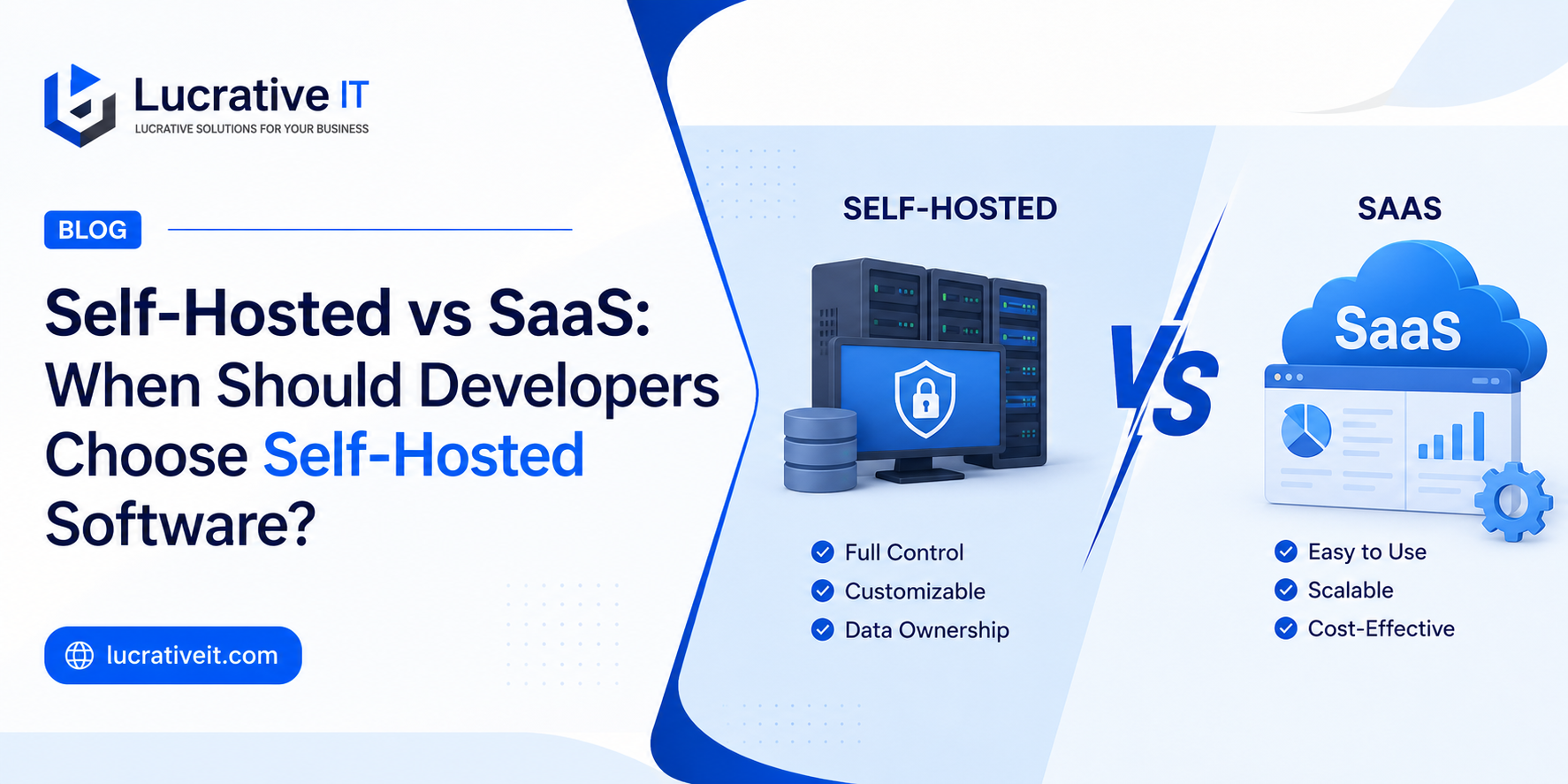
A practical, engineering-first comparison to help you decide whether to run your own stack or rent someone else's — based on cost, control, compliance, and long-term maintenance reality.
Every developer eventually hits this fork in the road: ship on a SaaS platform and move fast, or self-host and own the whole stack. Both are valid engineering decisions — but they optimize for different things, and picking the wrong one quietly taxes your product for years. This guide breaks down exactly when self-hosting wins, when SaaS wins, and how to make the call without guessing.
What "Self-Hosted" and "SaaS" Actually Mean
Before comparing trade-offs, it helps to be precise about what each model actually involves — because the terms get thrown around loosely, and the differences matter more at the infrastructure level than at the feature level.
Self-Hosted Software
Self-hosted software is a script, application, or platform that you install and run on infrastructure you control — your own VPS, dedicated server, or cloud instance. You own the codebase (or a licensed copy of it), the database, the environment, and every configuration decision. There's no vendor sitting between you and your data. Popular examples include self-hosted Laravel scripts, WordPress plugins installed on your own hosting, and open-source platforms like GitLab or Nextcloud deployed on your own servers.
SaaS (Software-as-a-Service)
SaaS is software delivered over the internet and hosted entirely by the vendor. You don't manage servers, databases, or updates — you log in, configure your account, and use the product through a subscription. The vendor owns the infrastructure, the release cycle, and, in most cases, a copy of your data. Think Shopify, HubSpot, or any tool you access purely through a browser and a monthly invoice.
The core distinction isn't features — it's control. Self-hosting trades convenience for ownership. SaaS trades ownership for convenience. Everything else in this article flows from that one trade-off.
Self-Hosted vs SaaS: The Core Trade-Offs
Here's how the two models stack up across the dimensions that actually matter to developers and technical founders.
You Own the Stack
- ✓Full control over data location, retention, and access
- ✓No recurring per-seat or per-usage fees
- ✓Deep customization at the code level
- ✓No vendor lock-in or forced migrations
- ✓Works well for compliance-heavy industries
- ✓One-time or perpetual license cost model
You Rent the Outcome
- ✓Zero infrastructure or server management
- ✓Automatic updates and vendor-managed security patches
- ✓Fast time-to-value, no deployment overhead
- ✓Predictable monthly operating cost
- ✓Built-in scaling handled by the vendor
- ✓Limited customization beyond vendor's roadmap
Side-by-Side Comparison
| Factor | Self-Hosted | SaaS |
|---|---|---|
| Upfront cost | Higher (license + server setup) | Low or free trial |
| Long-term cost | Lower at scale, no per-seat fees | Compounds as usage/seats grow |
| Data ownership | Full ownership, on your infrastructure | Vendor-controlled, shared responsibility |
| Customization | Unlimited — full source code access | Limited to vendor's settings/APIs |
| Maintenance burden | On you (updates, patches, backups) | Handled by vendor |
| Setup speed | Slower — requires deployment | Fast — sign up and go |
| Compliance control | Full control over data residency | Depends on vendor's certifications |
| Vendor lock-in risk | Low — you hold the code | Higher — migration can be costly |
| Scaling responsibility | Yours to architect and manage | Vendor's infrastructure absorbs it |
When Self-Hosted Is the Right Call
Self-hosting isn't the "harder but nobler" option — it's the correct engineering choice in specific, identifiable situations. Here's when it consistently wins.
1. Data sensitivity and compliance requirements
If you're handling healthcare records, financial data, legal documents, or anything governed by regulations like HIPAA, GDPR, or industry-specific data residency laws, self-hosting gives you direct control over where data lives and who can touch it. You're not depending on a third party's compliance posture — you own it end to end.
2. Cost predictability at scale
SaaS pricing is almost always structured around seats, API calls, or usage tiers. That model works fine at small scale, but it becomes expensive fast as your team or user base grows. A self-hosted script with a one-time license cost — like the Laravel scripts and WordPress plugins available on LucrativeIT — can pay for itself within months once you're past the SaaS tool's break-even usage point, and after that, it's essentially free to keep running.
3. Deep customization needs
If your product requirements don't fit neatly into a vendor's roadmap, self-hosted software gives you the source code to modify however you need. You're not filing feature requests and waiting — you're shipping the change yourself.
4. Avoiding vendor lock-in
SaaS platforms can raise prices, change terms, deprecate features, or shut down entirely, and you're often left scrambling to migrate. When you self-host, you hold the codebase. Even if a plugin author stops maintaining a product, your running instance keeps working, and you retain the option to fork or extend it yourself.
5. You're building a product to resell or white-label
Agencies and freelance developers building solutions for multiple clients often find self-hosted scripts far more economical than paying recurring SaaS fees per client. A single licensed script — a booking system, car rental platform, or event management tool — can be deployed repeatedly across client projects without stacking subscription costs.
Rule of thumb: if data control, long-term cost, or customization is non-negotiable for your use case, self-hosting almost always wins — even if it takes longer to get running on day one.
When SaaS Is the Better Choice
Self-hosting isn't always the right answer either. SaaS earns its place in plenty of scenarios.
1. Speed to market matters more than cost
If you need to validate an idea or launch a feature this week, SaaS removes the deployment and infrastructure work entirely. You're trading long-term cost efficiency for short-term velocity — a reasonable trade when you're still testing product-market fit.
2. You don't have DevOps capacity
Self-hosted software still needs someone to manage server security, apply updates, monitor uptime, and handle backups. If your team has no bandwidth for that, a well-run SaaS vendor's infrastructure team is doing a job you'd otherwise have to staff yourself.
3. The tool is a commodity, not a differentiator
For things like email delivery, analytics, or customer support ticketing — tools that don't touch your core competitive advantage — the operational overhead of self-hosting rarely pays off. Rent the commodity, self-host the differentiator.
4. Usage is small and unpredictable
If your usage is low or spiky, SaaS's pay-as-you-go pricing can actually be cheaper than provisioning and maintaining your own servers for a workload that doesn't justify the fixed cost.
A Simple Decision Framework
When you're stuck deciding, run through these four questions in order. The first "yes" you hit usually settles it.
Does the data need to stay under your direct control?
If compliance, client contracts, or data sensitivity require it — self-host. This overrides every other factor.
Will usage or seats grow significantly over the next 12–24 months?
If yes, model the SaaS cost at 3x your current scale. If that number is alarming, self-hosting likely wins on cost alone.
Do you need functionality outside the vendor's roadmap?
If customization is core to your product's value, self-hosted source code gives you the freedom SaaS can't.
Do you have the capacity to maintain infrastructure?
If not yet, start on SaaS and plan a migration to self-hosted once you have the DevOps bandwidth — or choose a self-hosted script simple enough to run without a dedicated ops team.
The Hybrid Reality Most Teams Land On
In practice, very few teams go 100% self-hosted or 100% SaaS. Most developers end up with a hybrid stack: SaaS for commodity infrastructure — email, monitoring, payments — and self-hosted for anything that's core to the product, sensitive by nature, or expensive at scale under a subscription model. The goal isn't ideological purity; it's matching each tool to the trade-off that actually serves your product and your budget.
That's also why the self-hosted script market has grown so much over the past few years. Developers and agencies want SaaS-quality functionality — booking engines, rental platforms, event management systems, subscription billing — without the recurring per-client fees. A licensed, self-hosted Laravel script gives you that: production-ready software you deploy once, own outright, and customize freely.
Own Your Stack Instead of Renting It
Browse self-hosted Laravel scripts and WordPress plugins built for developers and agencies who want full control, no recurring fees, and source code they can actually customize.
Explore the Marketplace